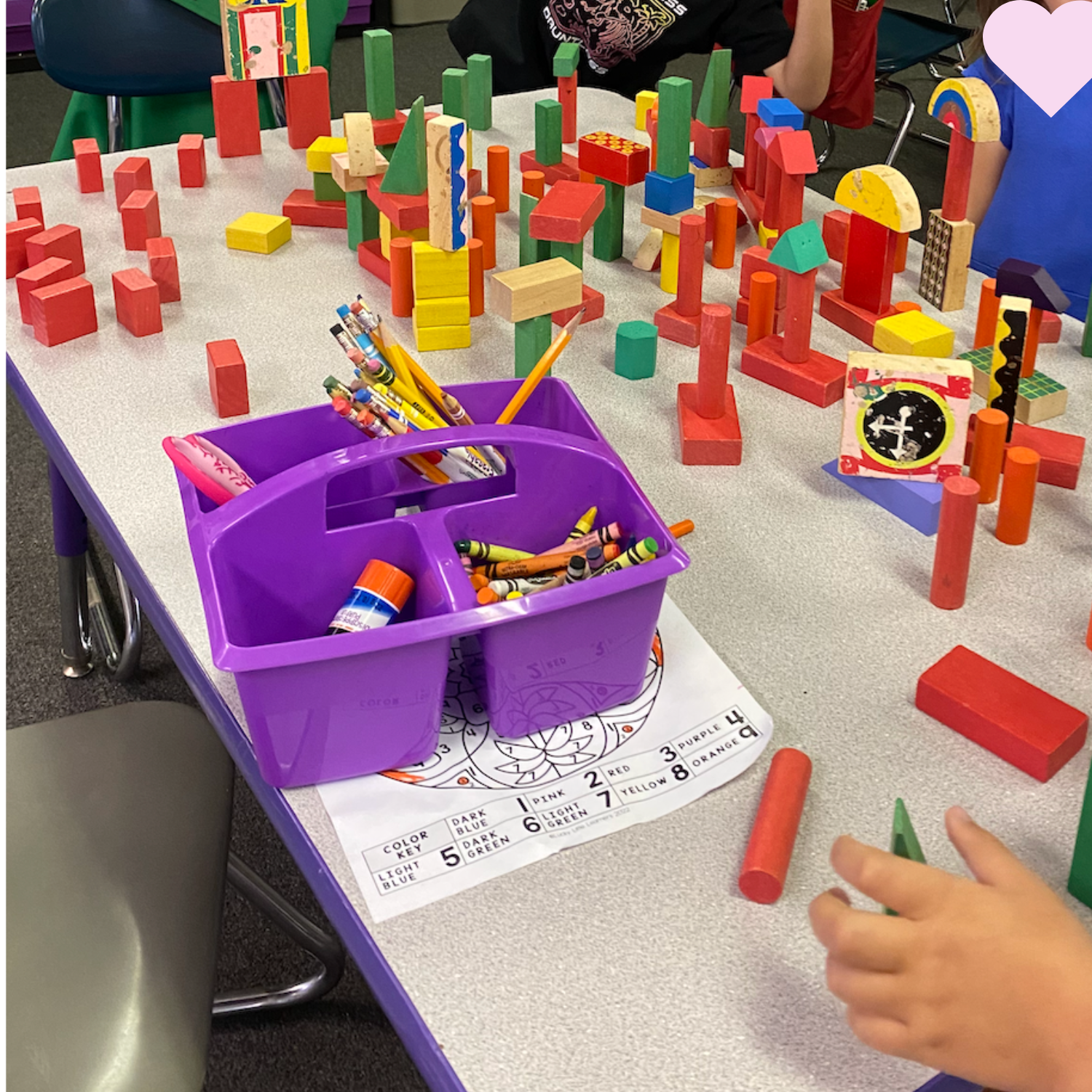
In 2015, the Lego Foundation funded Harvard University’s Pedagogy of Play Research Project to evaluate how play supports learning in schools. The findings were published in 2023 as a free resource titled A Pedagogy of Play: Supporting Playful Learning in Classrooms and Schools. Available for download here, it’s an essential read for anyone interested in the role of play in education.
My team and I began incorporating play into student arrival’s years before the book’s release. Wonder stations, also known as morning bins, became a superb start for all of us in the classroom, students and teachers alike. By incorporating wonder stations, we created an environment where students start their day with joy and curiosity, laying the foundation for a lifelong love of learning. For the youngest learners, supporting them at arrival, which could sometimes be a difficult transition, provided a softer start to the day. For teachers it gave us time to assess kid’s needs: who was hungry, who needed to tell a story, etc. etc. etc.
How and Why Wonder Stations Work
Play based activities work in a multitude of ways.
- The school day begins in a joyful, collaborative, and structured way.
- Stations don’t need to last for long; 20-25 minutes is usually enough time to keep students engaged.
- Late students can join without missing any essential morning work.
- While kids are at tables playing, teachers have time to get their bearings; see who is absent, grab breakfast for hungry kids, listen to and join conversations, and address expectations or re-direct depending on the situations that evolve.
- Students are learning while experiencing curiosity and exploration.
The Rules to Follow to Support Learning Through Play
- As kids enter the classroom, the first to their table chooses a bin.
- A timer is set as a visual so that kids know how much time they have to play.
- The rules state that if you already had a wonder station earlier in the week, you cannot pick the same one again.
- As new students enter, they go to their table, and begin to play with whatever bin had been chosen.
- Students stay at their tables, and aren’t allowed to move between stations. You get what you get, and you stay at your seat.
- Voice level 2 is expected, which for our classroom is what many people would call “inside voices.” If I can hear your voice above all of the others, you are too loud.
- At the start of the year, students receive verbal warnings about time running out. Later, once they are accustomed to the routine, they use the timer to self-assess and transition without teacher assistance.
- Our classroom had 10-15 stations, rotating based on effectiveness. Some materials like kinetic sand and Play-Doh were removed due to messiness.
- Some other wonder stations I’ve seen and loved are a handmade sewing stand with big fat needles and yarn, and a bin of magazines that students could cut and paste in new ways to create collage.
12 Products to Add to Wonder Stations
*please note that this post includes affiliate links. I may receive a small commission should users click and purchase products.


Ms. Martha