Hey teachers, have you noticed how shy your kids get when asked to speak to each other… gasp… in English? I have! Their embarrassment is overwhelming, and is seen in my 3rd through fifth graders, more so than the littles. I view it now as it as a bit of a phenomenon, because when my students speak to each other, or to me, their teacher, they can barely stop talking! Casual conversations with friends isn’t the same as discourse using academic language, though, and to my ESL friends the pressure sometimes feels heavy.
In an effort to “meet kids where they are, ” I’ve been working hard to create more opportunities for discourse that center on academic language. That, I’ve learned, is more challenging than I anticipated.
When designing activities, beginning with standards is, of course, the first step. Then determining the hook, which must includes an element of play, fosters the creativity. Before my students know it, we’re knee-deep in rich learning experiences where engagement and buy is quick. By intentionally incorporating time for kids to speak about academics, the more confident they become. Over these past few months, the formula has led to some wonderful (and sometimes surprising) successes.
Bringing Discourse to Life: Classroom Activities That Work
One of our first discourse activities this year was the “What Are You Good At?” lesson. Students explored verbs ending in -ing using flashcards as their speaking prompts. Inspired by the Responsive Classroom technique known as Maitre D’, where students move around the room (use a chime to alert them to stop) and share ideas with different partners. The low stakes activity gave student a purpose while they spoke, leading to fantastic interactions. Kids love opportunities to connect to their real-life experiences. What they were good at and what they weren’t good at were easy discussions because it felt authentic and personal. Following it up with a writing prompt was a natural and easy way to document the experience.

A compare and contrast activity built on movement and conversation. Students used picture cards to compare animals, objects, or scenes, discussing similarities and differences before writing about them. The vocabulary that came out of these moments was spontaneous and full of academic language. Afterward, students transferred their oral language into a quick writing activity, making the transition from speaking to writing feel natural and supported.

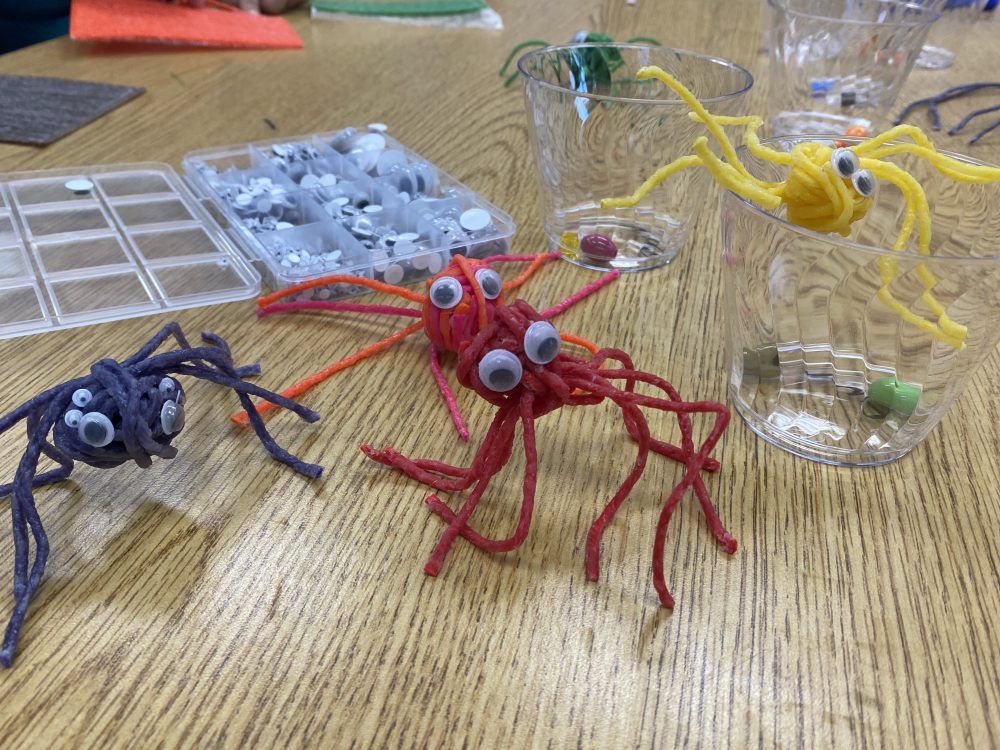
For the younger grades, the “Where Is Spider?” activity was a class favorite. First I created a slide deck/ mini lesson to accompany Kindergarten Chaos‘ “Where Is Spider?” cut-and-paste . Positional words are always tough for young language learners, so the opportunity for discorrse here seemed important. All of the 1st and 2nd grade students participated, but my third graders took it to another level making 3D spiders out of Wikki Stix and google eyes and hiding them all over the classroom! When the first graders came in the next day, they went on a spider hunt, using positional language to describe where the spiders were hiding. It was brilliant; fun, language, full of authentic communication.

Movement and Collaboration
When quick, purposeful lessons are followed by movement, collaboration, and writing, all four domains of language learning are naturally addressed and you start to see real growth. As a teacher, that moment becomes the hook that reminds me why I love the work. Teaching is harder than ever (hi behaviors), but when we follow the science and intentionally support every domain, everyone benefits. As I like to say, “When we love the lesson, we all learn.”

xo Ms. Martha